Cost of Living in Singapore: A Guide for Singles Living Alone
Before you move to any country, one question sits above all the others. How much does it cost to live there? For Singapore, that question comes up again and again, because the city has a reputation for being expensive. And when you are moving alone, every line of the budget is yours. There is no second income to share the rent, the bills, or the groceries.
I moved here on my own before my family joined me, so I remember that stage well. What I did not have back then was a clear number. I was guessing, comparing myself to whoever happened to mention their rent, and never really knowing if I was spending sensibly or not.
So instead of guessing, I asked. I ran a survey through a Google Form and collected real numbers from nearly 150 people living in Singapore. This article breaks down what a single person or someone living alone actually spends here in a month.
Because a single person’s budget bends heavily around their pass type, I have split the analysis into EP holders and S Pass holders. The two live quite differently.
Who answered the survey
The survey received 142 responses. Of those, 93 are EP holders (or the DP of an EP holder), 30 are S Pass holders, and 15 are Singapore PR holders. I used these 138 responses for the analysis.
EP holders are foreign professionals, managers, and executives, usually on higher salaries and specialised skills. S Pass holders are mid-level skilled workers in industries like construction, manufacturing, healthcare, and services.
I shared the survey link in a community WhatsApp group where the members are Sri Lankans working in Singapore. Some of my Indian and Indonesian friends here also filled it in. As a percentage, close to 95% of the respondents are Sri Lankans.
All amounts are in Singapore dollars. On the day I pulled these numbers (18 January 2025), the Google rate was 1 USD = 1.37 SGD.
What an EP holder spends living alone
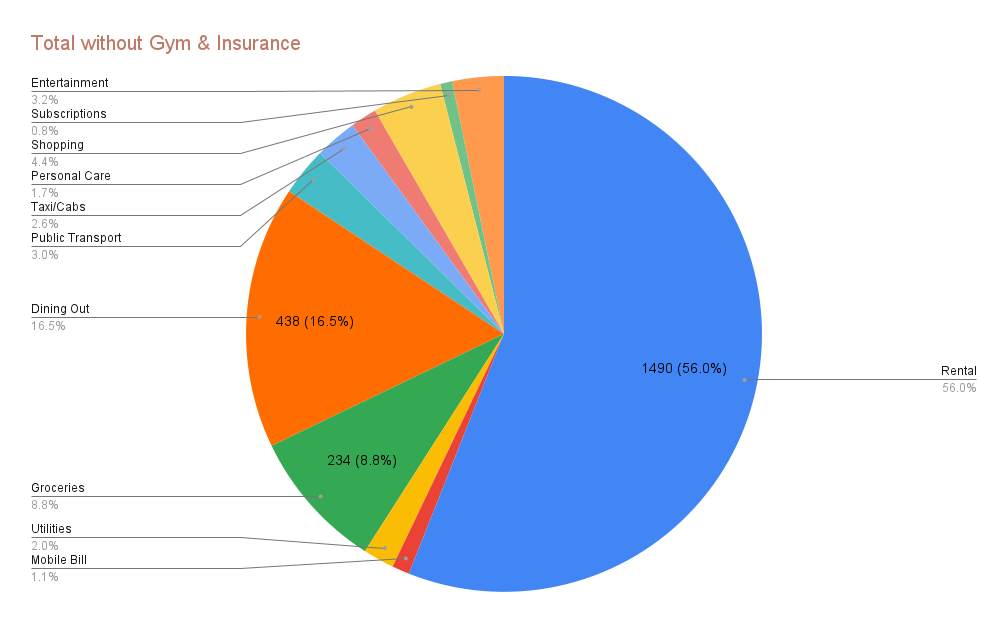
Here is the average monthly spend for Employment Pass (EP) holders who are single or living alone, based on the survey.
| Category | Monthly (S$) | Notes |
|---|---|---|
| Rental | 1,490 | |
| Dining Out | 438 | Restaurants and hawker centres |
| Groceries | 234 | Vegetables, fruits, meat, toiletries |
| Shopping | 116 | Clothing and footwear |
| Entertainment | 86 | Movies, sports, social outings |
| Public Transport | 81 | Buses and MRT |
| Taxi / Cabs | 70 | Grab and other ride-hailing |
| Utilities | 52 | Electricity, water, internet |
| Personal Care | 44 | Haircuts and spa |
| Mobile Bill | 29 | |
| Subscriptions | 20 | Netflix, Spotify, YouTube Premium |
| Total (without gym & insurance) | 2,660 |
Two lines sit outside that total because most people skip them. Gym adds about S$77 a month, but 73% of respondents do not pay for one. Insurance adds about S$144, and 68% do not pay for it. With both included, the total comes to around S$2,881.
So an EP holder living alone typically needs between S$2,500 and S$3,000 a month. The thing that stands out here is dining out at S$438, which is the second largest line after rent. Eat at home more often and this number drops fast.
What an S Pass holder spends living alone
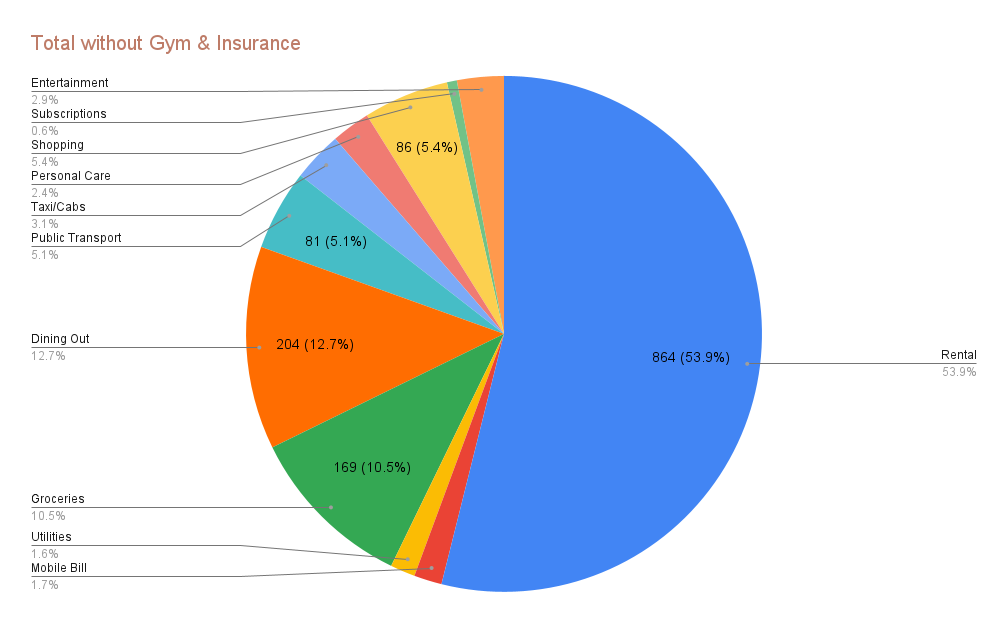
Here is the average monthly spend for S Pass holders who are single or living alone.
| Category | Monthly (S$) | Notes |
|---|---|---|
| Rental | 864 | |
| Dining Out | 204 | Restaurants and hawker centres |
| Groceries | 169 | Vegetables, fruits, meat, toiletries |
| Shopping | 86 | Clothing and footwear |
| Public Transport | 81 | Buses and MRT |
| Taxi / Cabs | 50 | Grab and other ride-hailing |
| Entertainment | 47 | Movies, sports, social outings |
| Personal Care | 39 | Haircuts and spa |
| Mobile Bill | 28 | |
| Utilities | 25 | Electricity, water, internet |
| Subscriptions | 10 | Netflix, Spotify, YouTube Premium |
| Total (without gym & insurance) | 1,603 |
The same two optional lines. Gym is about S$70 a month, and 73% do not pay for one. Insurance is about S$139, and 73% skip it too. With both included, the total comes to around S$1,812.
So an S Pass holder living alone typically needs between S$1,500 and S$1,850 a month.
Where the two differ
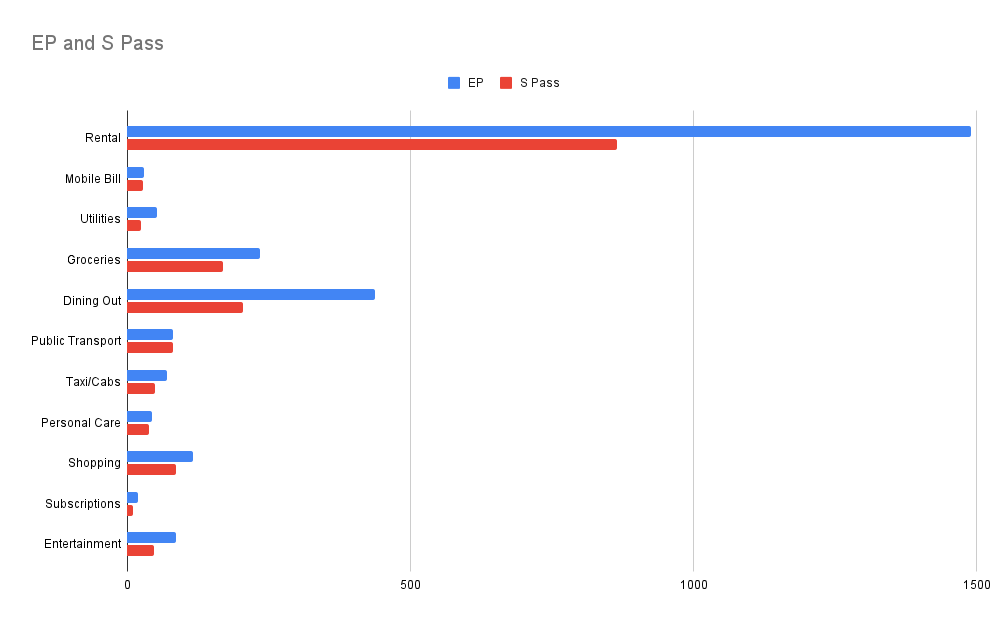
The gap between an EP holder and an S Pass holder is not one big line. It is the same lifestyle, lived at two different scales.
Rent is the biggest split. EP holders pay S$1,490 against S$864, mostly because they take private rooms while many S Pass holders share.
Dining out is more than double, S$438 against S$204. Utilities and groceries follow the same shape, S$52 against S$25 and S$234 against S$169. Transport on buses and the MRT is identical at S$81, but EP holders spend more on taxis. And the smaller lines, personal care, shopping, subscriptions and entertainment, are all a little higher for EP holders.
None of this is surprising. Higher income, more private space, and a bit more spent on comfort.
How singles arrange their rooms
The bigger the pass, the more private the room.
EP holders mostly live alone in their own space. 46.34% take a common room to themselves, 36.59% take a master room, and 14.63% rent a whole unit without sharing.
S Pass holders share far more. 58% share a room with someone, and 27% take a common room to themselves.
One term worth knowing if you are new here. A master room has its own attached bathroom. A common room uses a bathroom outside the room, usually shared with others in the unit.
Know your own number, not just the average
These figures tell you what other people spend. They cannot tell you whether your own budget is on track, or how long your savings would last if the income stopped. For that you have to sit down with your real numbers. I built a free financial plan sheet to work exactly that out.
If you want the rent side in more detail, I have broken it down room by room in a separate piece: Rental costs in Singapore for singles living alone. And if your plans have grown to include a partner or kids, the family cost-of-living guide picks up from there.
An average is only a starting point. The real cost of living here is your cost of living, not the survey’s. Read these numbers, then go and check your own. That is the part you actually control.
If this gave you a clearer picture, please rate the article with the stars just below. It takes a second and helps other people find it.
That’s it for today, guys. Thank You for Reading! I hope you found this article informative and useful.
If you think it could benefit others, please share it on your social media networks with friends and family who might also appreciate it.