A framework to select a country to live in or settle in
TL;DR
When making a critical decision like migration, compare a few options and select a suitable place based on the things that matter most to you. Don’t blindly follow your friend. If you think this article is too long, you can directly jump into the last section with the headline “HERE IS THE FRAMEWORK” to understand.
FULL ARTICLE
One of the most important decisions people make is where to live or settle. Choosing a country depends on individuals and elements, such as what people value in their lives and what they wish to preserve. We must accept that no country is perfect. Every country has advantages and disadvantages. As a result, a country that is ideal for one person may not be ideal for another. To avoid disappointment later, we should compare a few options (if possible) and select the best option.
Big Disclaimer
This writing is my opinion, and the framework I’m describing here is mine. Make careful to conduct your research before making any major decisions.
Why I am writing this article
Sri Lanka, as you already know, is an officially bankrupt country. It is experiencing economic difficulty, causing many social problems throughout the country. Skyrocketed inflation, long lines to fill up with gas, hours of power outages, and so on are all examples. As a result, many people are attempting to leave the country to settle elsewhere. Some people are attempting to leave Sri Lanka, at least temporarily.
An individual conducted this online survey. This survey had 6,785 responses, with 88% already migrated or intended to migrate. Out of 6785 people, more than 50% are IT experts. According to the survey, Australia, Canada, New Zealand, and the United Kingdom are the top-rated countries for migration.
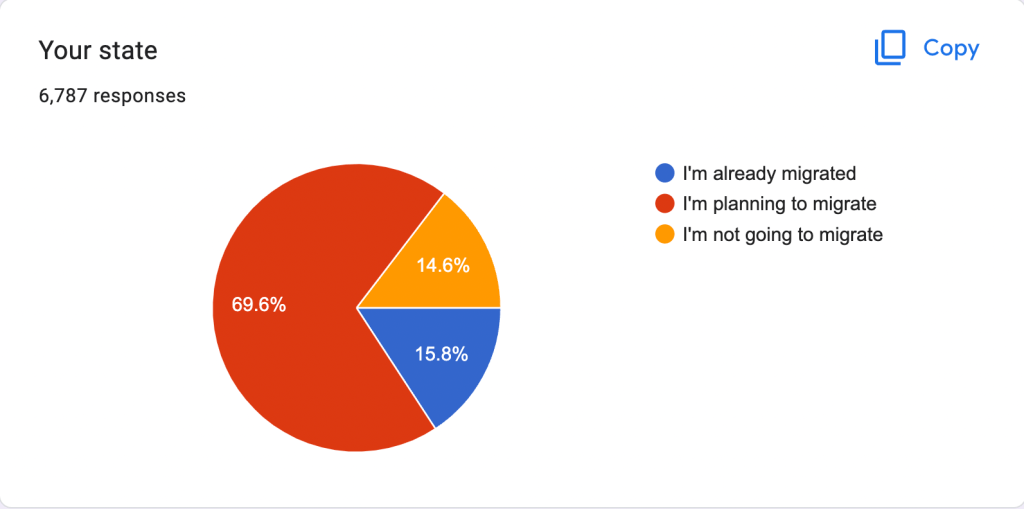
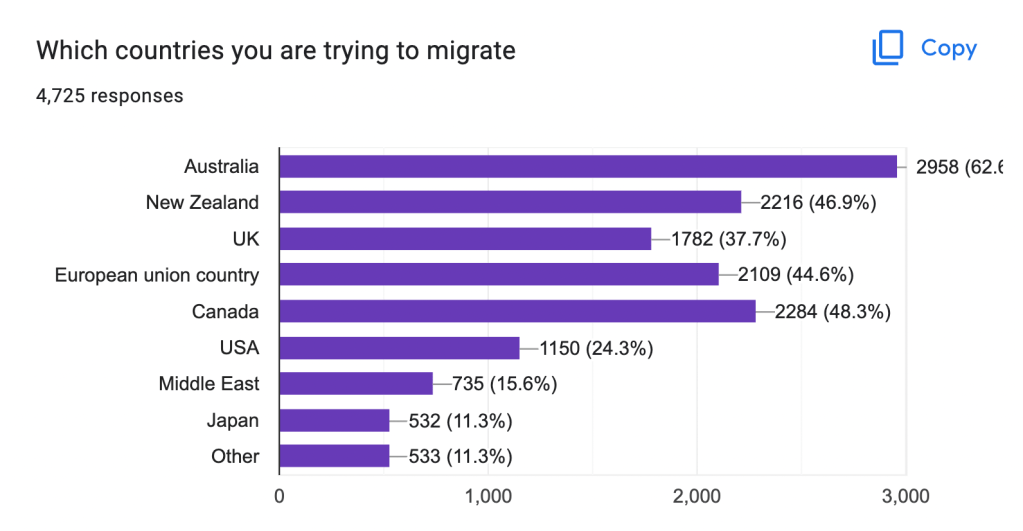
I recently spent two weeks in Sri Lanka and ran into some old friends and coworkers (the majority are working in the IT sector). When I spoke with them, I realized that the above survey results are fairly true. People are desperate to leave the country and are working tirelessly to find a method to move out of Sri Lanka. When I asked which country you wanted to move to, most said Australia, Canada, or New Zealand. When I questioned why you chose that country, the majority were speechless, or their answers highlighted that they did not know about the country they wanted to move into. That situation inspired me to write this article since I’ve observed that most people blindly follow someone they know or are heavily influenced by someone.
I understand that the majority of people have limited choices. On the other hand, people with an IT background have a better chance of choosing a country to relocate to because IT skills are in high demand globally, and many countries seek IT professionals from outside.
This framework is appropriate for someone who has several possibilities and wants to choose one.
Here is the framework
I came up with a list of factors you should consider before choosing a country to settle in. You can score 1 - 10 for each item on the list based on how much each factor matters to you. For example, the factor “Friendly Climate”. If the Climate does not matter to you and you are comfortable with extreme weather conditions, you can score low (maybe 1 or 2) for that factor. But if you find living in extreme weather conditions difficult, you can score high (8, 9 or 10 depending on how critical it is to you) for the “Friendly Climate” factor.
Here is the list of factors you should consider;
- Safety of the country
- The possibilities of finding a job in the same field
- Work right for the spouse (before becoming PR)
- Low cost of living
- Strength of the currency
- The average salary for your job role
- The quality of life
- General law of the country and the trust in the justice system
- Clear PR path
- Less time to become PR from the moving date
- Easy to become a citizen with PR status
- The rank of the passport
- Close to Sri Lanka
- Easy to get a visit visa for the family members (parents, siblings)
- English speaking country
- Free education for children
- The free public health system
- House affordability
- Affordability for a personal vehicle
- The quality of public transport
- Friendly local people
- Low tax rate
- High-speed internet connection
- Cleanliness of the country
- Friendly Climate (weather like native country)
- Religious freedom and friendliness
- Digitalization
- Current economic situations
- Neighbouring countries
- Political stability
- Business-friendly and easy to start a business
- Taxes on investments like the stock market
- Retirement benefits
- Job security
- Culture
- Native community
- Allow dual citizenship
- Freedom of speech (i.e. protest)
- Easy to travel
- Existing family member(s) live in the same county.
Once you provide a score from 1 to 10 for each factor in the above list, enter the countries you are considering. Then give a comparative score to each country for all the factors.
Consider the “Close to Sri Lanka” factor. Assume you prefer to visit Sri Lanka twice a year. Therefore, staying close to Sri Lanka is important to you. Hence, you can rate the “Close to Sri Lanka” factor as 9 or 10. Consider your options: Canada, New Zealand, and Australia. Give separate scores (from 1 to 5) to each country comparatively.
I am giving Canada 2, Australia 5, and New Zealand 3. Now multiply the country score by the factor score. It will come to;
- 10 x 2 = 20 for Canada
- 10 x 3 = 30 for New Zealand
- 10 x 5 = 50 for Australia

If you only consider the factor “Close to Sri Lanka,” you must choose Australia because it has the highest score in the previous example.
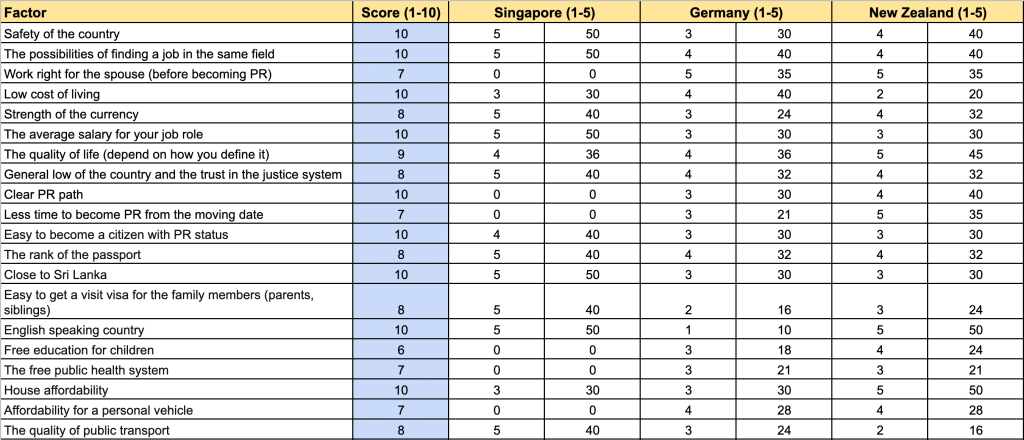
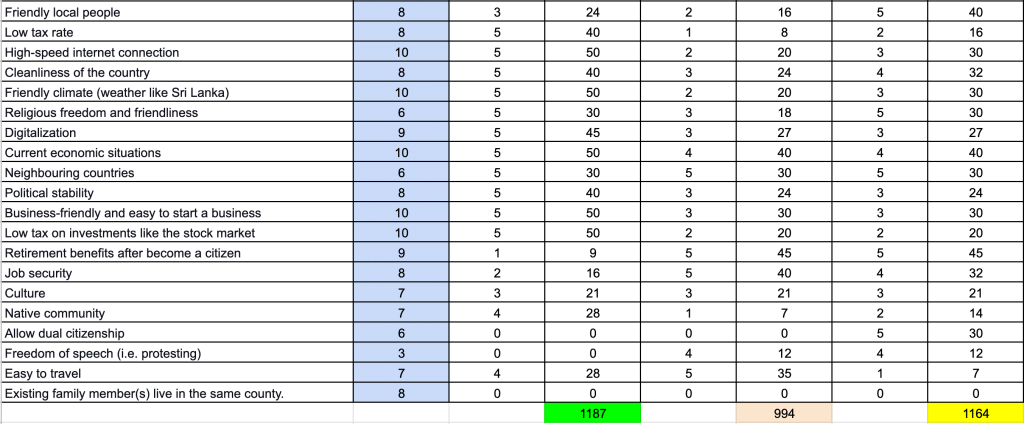
Please refer to the table below for a better understanding. I compared Singapore vs Germany vs New Zealand to better understand the framework.
The scores I have provided to each country on the chart below are just sample numbers, and I put them as per my job, my spouse’s job, my values, my wishes and my future plans. Please do not consider each country’s score on the chart above for your research. I urged you to do your own studies before providing a score.
Consider looking at the below chat on a laptop for better visibility.
Here you can find the link to the spreadsheet.
As you can see in the example above, Singapore receives the highest score. However, the value you assign to each factor and country is entirely up to you. For example, give a higher score if you have children and are looking for a country with a free education system. You may give a low score if you are willing to pay some money for your children’s school fees. Give a score of zero if the free education factor does not apply to you. It is up to you how you evaluate each factor and how much matter it is to you.
For example, “The possibilities of finding a job in the same field”. Finding a job in the same field is really important. Therefore, I provided 10 out of 10 for that factor. Since I am in the IT field, finding an IT job in Singapore is relatively high. Hence, I provided 5 out of 5 for Singapore. Compared with Singapore, finding an IT job in Germany is slightly challenging (as per my experience). Therefore I provided 3 out of 5 for Germany. If you are a Banker, you have to do your research and rank each country for the possibilities of finding a banker job. I hope you got an idea of how the above table works.
That concludes my framework. Remember that people’s opinions and decisions are naturally biased. People will naturally defend their point of view. Therefore, it is best to conduct extensive research and compare several options when making a critical decision. Do not just blindly follow someone. As I mentioned, a country that is ideal for one person may not be ideal for another.
Thank you for reading. If this is useful, consider sharing this with your family members and friends who are desperately looking to move out of Sri Lanka.
If you have anything to say, consider adding your opinion as a comment.
That’s it for today, guys. Thank You for Reading! I hope you found this article informative and useful.
If you think it could benefit others, please share it on your social media networks with friends and family who might also appreciate it.